
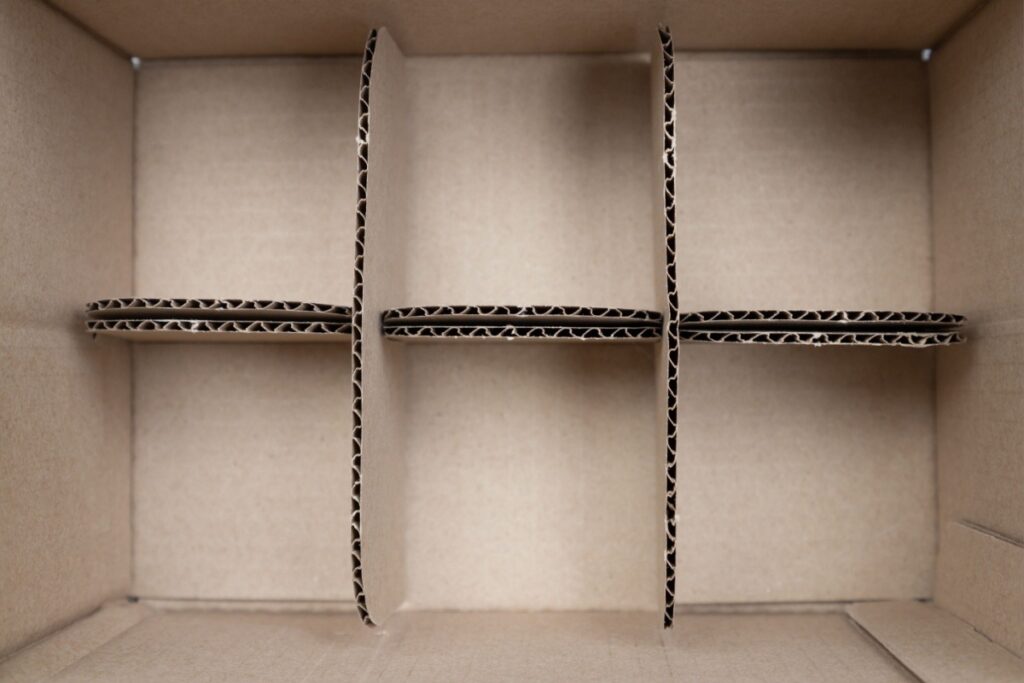
When businesses think about a box or packaging solution, attention often goes straight to box size, exterior strength, or shipping cost. One detail that frequently gets overlooked is partition thickness. For companies shipping products inside a carton, the thickness of internal partitions directly affects protection, presentation, and overall performance across the supply chain.
At General Partition, we work with customers across manufacturing, logistics, and distribution who rely on box partitions to protect products inside a cardboard box. Thickness is not a cosmetic choice. It influences cushioning, stability, material efficiency, and how products move through a system from prototype to full-scale production.
Understanding Box Partition Thickness
Partition thickness refers to the thickness of the material used to create internal dividers. These partitions form individual cells inside a custom box, keeping units separated and protected during transit and storage.
Thickness varies based on material type. Corrugated fiberboard, chipboard, and SBS partitions each behave differently under load. A thinner partition may reduce material cost and waste, but it may also compromise protection. A thicker partition increases rigidity and impact resistance, but it must be matched to the product and carton design to remain efficient.
Ultimately, choosing the right thickness means balancing protection, quantity, and performance without creating unnecessary bulk.
How Thickness Impacts Product Protection
Partition thickness plays a major role in cushioning and structural integrity. When products shift within a carton, impact forces are transferred to the partitions first.
Thicker partitions provide:
- Better resistance to compression and sidewall pressure
- Improved shock absorption for fragile items
- Stronger separation between cells
This is especially important when shipping glass, cosmetics, metal components, pipe fittings, or products with mixed dimensions. A thin partition may bend or collapse, while a thicker corrugated board partition maintains separation and reduces damage.
In high-risk shipments, thickness acts as a protective buffer, much like framing in construction supports drywall or how laminated glass supports safety in interior systems.
Matching Thickness to Product and Box Size
Partition thickness must align with the product dimension and box size. Oversized partitions can reduce usable space, while undersized partitions can lead to movement and damage.
Key factors we evaluate include:
- Product weight and shape
- Quantity of units per carton
- Interior clearance between cells
- Load distribution across the floor of the box
A well-designed partition system fits the product without wasting space. This improves packing speed and reduces material usage across the supply chain.
When Thicker Is Not Always Better
Using the thickest possible partition does not always lead to better results. Excess thickness can create issues in automation, palletization, and overall logistics.
Potential drawbacks include:
- Increased material cost
- Reduced number of units per carton
- Higher shipping weight
- Added waste at scale
This is one area where it is not strength alone, but a balance between protection and efficiency. A well-engineered partition often uses the minimum thickness needed to perform reliably.
Thickness and Custom Box Design
Custom box projects benefit most from thoughtful thickness selection. During the prototype stage, testing different partition thickness options allows us to evaluate protection, assembly, and packing speed before scaling.
Custom box partitions support:
- Faster assembly for box dividers
- Cleaner alignment within cartons
- Consistent performance across large production runs
This approach helps brands reduce damage, improve consistency, and maintain a professional presentation from manufacturing through delivery.
Sustainability and Material Efficiency
Partition thickness directly affects sustainability. Using the right amount of material reduces waste and supports environmentally friendly goals without sacrificing performance.
Thinner but properly engineered partitions:
- Use less paper and fiber
- Reduce shipping weight
- Improve recycling outcomes
Selecting the correct thickness is one of the simplest ways to improve packaging efficiency without compromising protection.
Designed for Performance Across the Supply Chain
From production floors to warehouses and final delivery, partition thickness influences how packaging performs across the supply chain. Consistent thickness supports better stacking, safer transport, and smoother handling in logistics environments.
When packaging works as intended, it protects the product and the brand at every touchpoint.
Talk With Us About the Right Partition Thickness for Your Packaging
At General Partition, we help companies choose box partitions that match their products, cartons, and operational needs. Our team designs partition solutions that balance protection, material efficiency, and performance across real-world conditions.
If you are evaluating a new custom box, refining an existing partition system, or preparing for a new manufacturing run, we are ready to help. Contact our team to discuss materials, thickness options, and how the right partition design can improve your packaging results.