
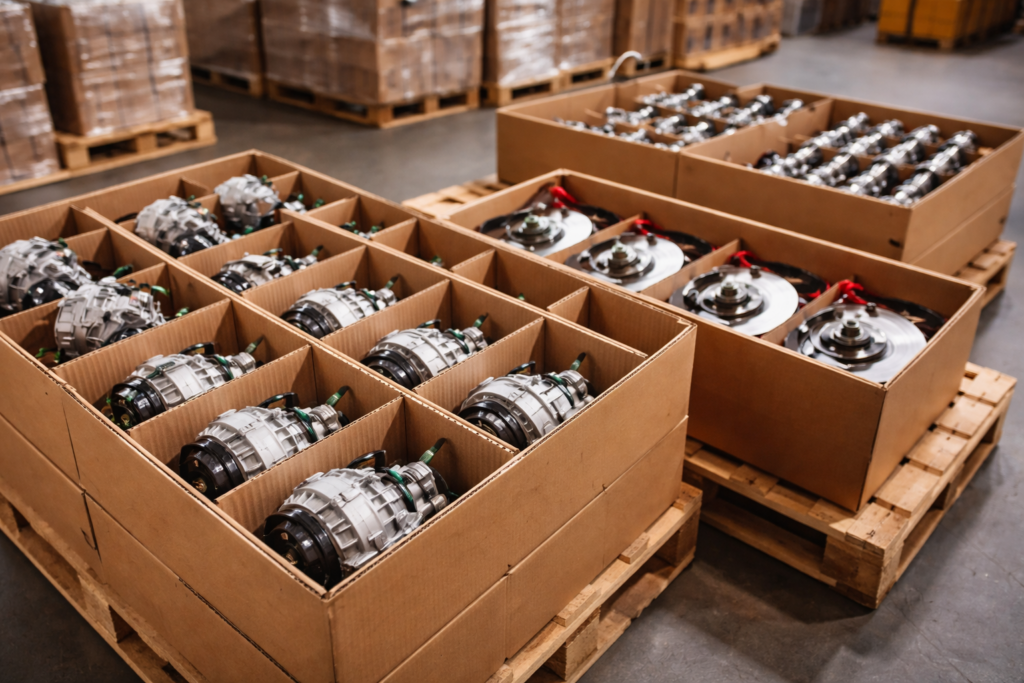
In the automotive industry, part integrity isn’t optional. Whether components are moving between plants, heading to Tier 1 suppliers, or shipping directly to OEM facilities, even minor damage can disrupt production schedules and increase costs.
While much attention is placed on exterior packaging (cartons, crates, or pallets) the box partitions inside those containers are often what truly prevent damage. Automotive packaging partitions play a critical role in stabilizing components, preventing contact damage, and maintaining product quality throughout the supply chain.
If you’re evaluating ways to reduce breakage, surface damage, or handling inefficiencies, it’s worth taking a closer look at how internal partitions contribute to overall performance.
Why Internal Separation Matters in Automotive Shipments
Automotive parts are rarely uniform. Even when parts are durable, many have:
- Precision-machined surfaces
- Coated finishes
- Delicate connectors or electronic components
- Sharp edges that can scratch adjacent parts
When parts are packed loosely inside a carton or crate, they can shift, vibrate, and collide during transport. That movement leads to:
- Surface abrasion
- Edge chipping
- Finish damage
- Bent or stressed components
Box partitions create defined compartments inside packaging, isolating each part and reducing movement. Instead of relying on filler material, box partitions physically separate components and distribute load evenly throughout the container.
What Automotive Partitions Actually Do
Automotive box partitions are engineered inserts placed inside cartons, chipboard boxes, or reusable containers. Their primary job is separation, but their benefits go far beyond simple dividers.
Well-designed partitions help:
- Prevent part-to-part contact
- Stabilize components during vibration
- Maintain spacing under stacking pressure
- Improve packing and unpacking efficiency
- Support accurate part counts
Because partitions are custom-sized for the application, they allow manufacturers to maximize container space while maintaining protection standards.
Where Partitions Are Commonly Used in Automotive Applications
Partitions are particularly valuable when shipping:
Small Precision Components
Sensors, fasteners, bushings, clips, and electronic assemblies benefit from individual compartments that prevent abrasion or misalignment.
Finished or Coated Parts
Powder-coated or painted components are vulnerable to surface damage. Partitioning prevents scuffs that can result in cosmetic rejects.
Glass or Fragile Automotive Elements
When transporting automotive lighting components or glass assemblies, separation is essential to prevent cracking or impact damage.
Machined Metal Parts
Sharp or high-tolerance edges can damage adjacent parts without separation. Custom chipboard or specialty board box partitions protect these surfaces during transport.
Corrugated Partitions vs. Other Separation Methods
In many automotive environments, chipboard partitions are preferred because they offer a balance of durability, flexibility, and cost control.
Compared to loose fill or foam inserts, chipboard partitions:
- Provide structured, repeatable spacing
- Are easy to assemble and pack
- Can be customized to exact dimensions
- Support stacking strength
- Offer recyclable material options
For high-volume production environments, this consistency improves packing line efficiency and reduces variability.
Operational Benefits Beyond Damage Reduction
While preventing breakage is the most obvious benefit, automotive partitions also support operational improvements.
Faster Receiving and Inspection
When parts are organized into compartments, counting and verification become quicker and more accurate.
Safer Handling
Defined compartments prevent parts from shifting unexpectedly when cartons are opened, reducing the risk of injury.
Improved Inventory Control
Partitions help maintain consistent pack quantities and prevent mixed SKUs in a single container.
Reduced Rework and Claims
Fewer damaged parts means fewer returns, warranty issues, and production disruptions.
Over time, these operational advantages contribute to measurable cost savings across the supply chain.
Designing Partitions for Automotive Applications
Not all partitions are created equal. Effective automotive partition design considers:
- Part dimensions and tolerances
- Weight distribution
- Stack height and pallet configuration
- Transit conditions (vibration, handling frequency)
- Container type (single-use corrugated vs. reusable totes)
By matching partition strength and configuration to the part and shipping environment, manufacturers can avoid over-packaging while still protecting critical components.
Why Partitions Are a Strategic Investment
In automotive manufacturing, margins are tight and schedules are unforgiving. A small percentage of damaged parts can translate into significant operational disruption.
Internal partitions may not be the most visible part of a shipment, but they are often the difference between:
- A smooth receiving process and a rejected load
- Protected surfaces and cosmetic defects
- Efficient packing lines and repeated handling
When evaluated properly, box partitions are not just inserts, they are part of your quality control strategy.
Protect Your Assets
Protecting automotive components requires more than strong outer packaging. The partitions inside the box are what stabilize, separate, and safeguard parts during transit and storage.
For manufacturers, suppliers, and logistics teams looking to reduce damage, improve handling efficiency, and maintain product integrity, evaluating internal partition design is a smart place to start.
Because sometimes the most important protection isn’t what surrounds the package, it’s what separates what’s inside.